In a year drowned in tears, in order to wash away the disappointment, only here, I couldn’t lose.
In a year where joy was forgotten, for us to reclaim that spark, only here, I don’t want to lose.
(Translation found on the Umamusume wiki)
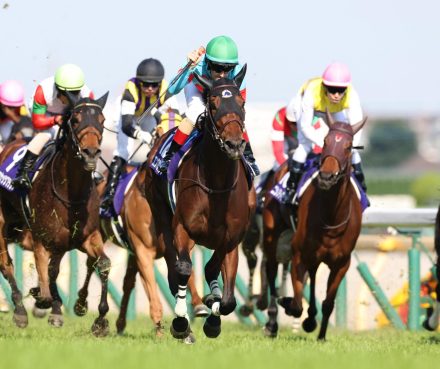
The race to determine the best short-distance female racehorse of the season is over with everything going surprisingly as expected. The top 3 favourites all placed on the podium in order with numerous funny sequences happening in the finishing order. There might not exist a dramatic shake-up in how the underdogs have performed, but the answer lies bare for all to witness. The Victoria Mile’s conclusion rings onto the fate of its participants.
Final Results (In a Nutshell)
Finish in order

It is not every day when the wisdom of the masses has gone exactly as expected. Embroidery collects her third G1 title by claiming victory in a relatively dominant fashion after making use of the tempo to catapult herself to the finish line. Kamunyak nabs second place despite being in a similar position as with Embroidery which speaks for her comfortable affinity with longer distances. Queen’s Walk barely claims third place in a photo finish to add another top 3 placement to her resume.
Position at bends

Sectional Times

Amateurish Analysis (Top 3)
Well, there has to be something about the best-performing racehorses in the race to warrant a deeper look into why they are able to excel as well as they did. In focusing on the top 3, we can look into both the moves made and the context surrounding their pedigree and their race records.
Embroidery
Embroidery sets herself up as a clear top miler of the country with what is largely a breezy win in the Victoria Mile. With Christophe Lemaire as her main jockey, you can see how he makes good use of her proven ability to run up to 2000m by running her from the outside. This is similar to what had happened in the NHK Mile Cup where the top performers all run to the outside before making use of their spurts to reach the finish line without feeling too worn out. Analysts argued that the ground that’s close to the inner rail in Tokyo Racecourse is more uncomfortable for racehorses to run on which explains the disproportionate favouritism towards vying towards the outside.
That being said, it didn’t quite answer the seeming ease of which Embroidery is able to claim the title. Her L3F time is 33 seconds which puts her tied with Kana Tape for being the 3rd fastest while Kamunyak and Queen’s Walk are slightly slower compared to her by 0.1 second. While the latter two’s performance can be attributed to how they take up more time to ready their spurt, Embroidery has shown the clear reaction needed to claim the win by more than 1 length. Just before the 200m mark to the finish line, Lemaire used his whip to which she responded almost immediately with more rapid strides which elongated her lead to further cement her victory.
It’s hard to see where Embroidery will go next with her win and she still has a bit of time left to win more G1s before retiring as she’s 4 years old. The race should grant her an automatic berth to the G1 Breeder’s Cup Filly and Mare Turf which tends to be held in the United States in November. Additionally, there’s also another berth towards the G1 Prix Jacques le Marois in France around August which stands as one of the country’s premiere races for short-distance specialists. Lemaire’s post-race comment according to sources like Bloodhorse implies that she’s ready for an overseas trip barring her disastrous showing in last year’s Hong King Mile. Wherever she’ll go next, the world is now her oyster.
Kamunyak
Forgive me for the misspelling of her name as “Kamulyak” in the last blog post; it’s a chronic habit of mine to assume that there’s an “n” instead of an “l” in her name. I’ll get that fixed right after this piece. Aside from that, Kamunyak’s performance is a solid testament to both her brutish strengths as one of the most hyped mares of last year’s Triple Tiara generation and her reliance on it to push through in a mile-long race. While Embroidery’s win shows how perfectly she fits as a miler, Kamunyak’s win can be attributed in part to positioning and her jockey Yuga Kawada’s instincts in shorter distances.
The moves Kawada had made to ensure Kamunyak’s placement are simple, but they’re fundamental in fixing her lack of affinity in running on shorter distances. As a start, he placed her between Jocelyn and Lavanda until the final corner as if to ensure that she makes the most optimal turn possible. This allows her to not lose too much speed in the process which is really important keeping in mind her L3F time of 33.1 seconds. It does look quick on the outside, keeping in mind the usually fast tempo in Japan. Yet this 1 extra millisecond could have determined whether or not she’ll be facing a 4-way photo finish with Queen’s Walk, Erika Express, and Coconuts Brown with the latter two having to make due on more awkward circumstances.
Another key move that Kawada made to optimise Kamunyak’s performance is a more aggressive use of whipping and reining compared to Lemaire’s. Here you can see the importance of chemistry between the jockey and their main ride. Kawada might have already been aware that Kamunyak is more suited for 2000m or more and with the shorter distance, she’s more likely going to react slowly to getting her spurt going. Throughout the final straight, you can see him throwing his reins aggressively and using his whips more frequently. This urgency allowed Kamunyak to gradually pick up speed and therefore get her ahead of the others even if she’s behind Embroidery.
I doubt that Kamunyak will enter any more mile-long races afterward and it’s in the best interest of her trainer to target something like the G1 Takarazuka Kinen at the latest. That being said, you can commend Kawada for making the best moves possible on a racehorse who is quite literally not built for running in a mile.
Queen’s Walk
With Kawada leaving her for Kamunyak for the race and with a possible one-time partnership with Atsuya Nishimura, Queen’s Walk falls into a similar predicament with many mares in the race. It feels like she’s caught in a kerfuffle over the decision-making of her jockey who isn’t entirely acquainted to her strengths and weaknesses and she’s in a distance that she rarely ran in. Granted, she did place second in the same race last year. She did however get caught in weird positions that didn’t make the best of her performance.
Nishimura puts her towards the back half of the pack and while she’s positioned towards the outside, it’s worth keeping a reminder that her spurt isn’t exactly the best. Keep in mind that in the Autumn Tenno Sho last year where the tempo is slow, her L3F time is several milliseconds slower than the likes of Masquerade Ball, Museum Mile, and Shirankedo even if it’s below 33 seconds which puts her in 9th place. Here and with the average time of 11 seconds roughly per furlong, her L3F time is the same as Kamunyak’s – 33.1 seconds. Sure, the tempo is fast, but there are clear optimisations to be made.
Looking at her race records, Queen’s Walk is capable of going on-pace, running in midfield, and closing in from the rear. With the reminder of her Autumn Tenno Sho performance, the one option that might have been for the best given the fast tempo of the Victoria Mile is to go for the front half. Be more aggressive in overtaking and boxing Kamunyak in and even be willing to use your whip pre-emptively to try and avoid the brief boxing situation. The performance here is a clear message surrounding the importance of why it’s worth having your main jockey around especially in a sex-restricted race like this. Nishimura has done the best he could, but you can tell how much he lags behind in knowing Queen’s Walk compared to Kawada whose jockeying might have handed Kamunyak the runner-up spot.
Amateurish Analysis (Other Competitors)
For the rest of the entrants, some have made moves that might have shaped the very way the race is run which makes for unexpected leanings that play to the advantage of others. This section is for those who either had done better than expected even if outside the top 3 or have shaped the race in a way that might have tilted the results in favour of others.
Erika Express and Nishino Ti Amo
Erika Express has got almost everything she might have wanted. She’s the pacesetter, was able to run the most optimal way possible up to the final corner, and fend off against other spurters on the final straight to place 4th. Maybe the closest possible issue is that her jockey Yutaka Take didn’t quite push her to do a runaway although with Nishino Ti Amo tailing right behind her, it’s hard to see whether that’s a move that will certainly pay off. That and with the tempo being as fast as it looks, the additional boost might only help Nishino Ti Amo all the more. All things considered, Erika Express did the best she could and I wouldn’t be surprised if she wins a graded title down the line. Maybe even a G1 should she take part in a race with a shorter final straight like the Mile Championship in Nakayama.
Nishino Ti Amo’s 6th place is a clear sign that while she did the best she could, her best performance lies in longer distances than the mile. I wouldn’t say that she “gassed out” on the final straight so much as she did at least place right outside the top 5 and that this is the shortest distance she ran on so far. Instead, her showing is similar in respect to Kamunyak’s. Her jockey Akihide Tsumura is the one doing everything to give her the best ride possible which includes trying to seize the lead from Erika Express and holding out to the end. This sadly isn’t enough for Ti Amo as she showed herself to be even less built for running in the mile than Kawada’s ride. Her L3F time of 34.1 seconds is a sign of her lagging acceleration that would have been forgivable had the distance been an extra furlong long…
Coconuts Brown
Every now and then, you get a racehorse whose placement might not have looked as impressive as you would have thought. Coconuts Brown got into the top 5 at least, but her quest for the graded title continues on even as she proves herself to be dependable. She’s a clear loser out of the 3-way photo finish for 3rd place by a head. And it seems like she isn’t suited for the mile-long races given how her experiences with it only comes when she’s grinding out of allowance class.

Rewatching the race however, there is an impressive showing to be seen in Coconuts Brown even as her journey to collect 1 graded title continues on. She ran from the inside throughout the race despite theoretical assumptions that the turf there is more unsuited for the fast tempo especially on the final straight. The additional risk of being boxed in also posed a major risk to her and her main jockey Yuichi Kitamura in navigating their way out to a solid finish. Instead, they opt to go for patience and take the path of most resistance – avoiding the wide turn on the final corner that characterised many of the top finishes in Tokyo Racecourse.


In the final straight however, Coconuts Brown has shown a devastating bit of individual performance despite her placement. Angled in the middle with a seeming chance at being blocked, Kitamura simply gets the whip out and her response is an immediate spurt. From there, she evades almost any kind of collision to clock the second fastest L3F time of 32.9 seconds – just a millisecond short of Embroidery’s more optimised run. Even if she lags behind Erika Express and Queen’s Walk by a head, this showing is a major sign for why she remains a popular betting favourite. She’s that reliable in what she does.
Lavanda, Jocelyn, and Bond Girl
Lavanda, Jocelyn, and Bond Girl bottomed out of the race with the respective placement of 7th, 8th, and 11th. While the spurting speed might have been different with Bond Girl’s being the fastest of the three (33.3 seconds which still lags behind Embroidery’s by 3 milliseconds), the main reason for their placement points towards one common theme. They struggle to navigate their way around other racehorses and it’s not so much a common boxing problem.
All three got their spurt ready for the final straight, but the missed opportunity by their jockeys meant that they were unable to pick up on their speed. Jocelyn proves to be hesitant to swing towards the outside which leads to Queen’s Walk going well ahead of her. Lavanda on the other hand is holding on to her spurt for too long essentially as her jockey Mirai Iwata opted to maintain her speed to bypass Ka Pilina. By the time she’s in a free enough space to run to her fullest, all the others are already at full speed which means that her quick turn of foot is for nought. Bond Girl’s jockey Yuji Tanmai might have made a massive blunder by going towards the inside for a spurt rather than go towards the outside aggressively. This means that she lags considerably well behind others by the time there’s the space for her to spurt.
Drop of Light

As for my upset pick in Drop of Light? Rewatching the race again, Drop of Light might have fallen to a lot of hesitancy based on her showing. Her jockey Fuma Matsuwaka opted to put her towards the rearmost position in a massive gambit that didn’t pay off. While she’s able to clock the same L3F time as Coconuts Brown at 32.9 seconds, it’s all too far for her to catch up to the rest. Additionally, despite her versatility in position based on her race records, the positioning is seemingly inspired by her G3 CBC Sho performance last year where she’s able to clock in at 32.3 seconds in the sprinting-oriented race. As unfortunate as the showing is, both Matsuwaka and Drop of Light’s trainer Yuichi Fukunaga might have been kicking themselves for misreading their racehorse’s biggest strength in the G1 lineup.
Leave a Reply