It shines brightly for just a moment, then it drifts freely upon the waves.
As each one pursues their way of life, I too have my own aspirations.
Like a roaring fire, I will forever burn bright.
(Translation by the Umamusume wiki)
From across the sea, a female trainer forever etches her name on one of the world’s most important races in the Kentucky Derby. At home, a female jockey writes poetry through her reins, the inks being the dirt that leaves the letterings to congratulate her historic win of the Japanese Oaks. Those who doubted the fillies or mares, the women who work as grooms or vets, or as jockeys or trainers will fall victim to their might.
Final Results (In a Nutshell)
Finish in Order

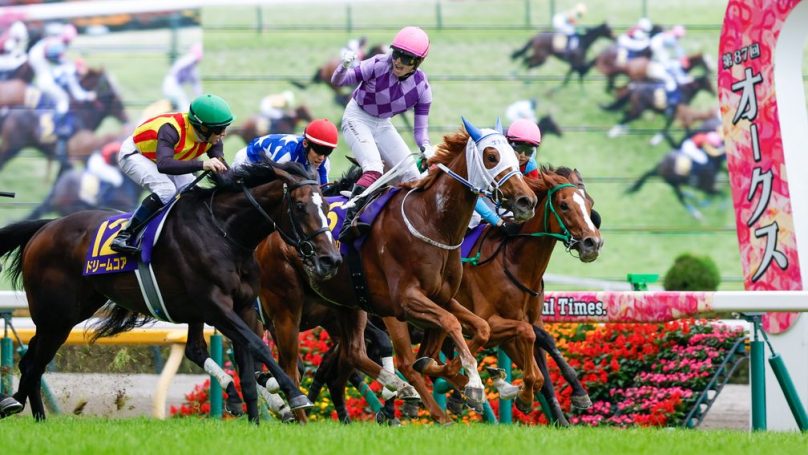
A miracle has happened on the tracks as the dreamer flies toward glory. Juryoku Pierrot shoots her way to victory to both add a major credential to her father Orfevre’s legacy as a sire and an even more historic achievement to her jockey Seina Imamura as the first domestic female jockey to win an international G1 in her home country. Dream Core snags 2nd place thanks to an on-pace position that allows her to ride on the momentum. Laughterlines got into a hiccup on trying to unleash her spurt, but she at least is able to slip into 3rd place.
Positions at bends

Sectional Times

Amateurish Analysis (Top 3)
Well, there has to be something about the best-performing racehorses in the race to warrant a deeper look into why they are able to excel as well as they did. In focusing on the top 3, we can look into both the moves made and the context surrounding their pedigree and their race records.
Juryoku Pierrot
If there’s ever a star whose performance is worth all the commendation, it’s Juryoku Pierrot and her main jockey Seina Imamura. Up until the Japanese Oaks, the two have been on a journey. The initial bid to run on dirt to follow the path of Ushba Tesoro and Marche Lorraine is a struggle due to the more sandy type being favoured by frontrunners. The switch to turf yields much more success with two consecutive wins despite underrated betting odds although they’re not graded titles. In the Oaks, they are up against a horde of tough opponents ranging from ambitious stars like Laughterlines and Star Anise to untapped potentials like Enne. This is the biggest spike in competition the two have ever faced up against and it doesn’t help that this marks the first time Imamura is riding in Tokyo Racecourse.
And yet the two prevailed against the odds. Even the last-minute shift in betting odds over doubts regarding Imamura didn’t leave the jockey stressed out so much as to seemingly orient her focus on providing the best ride even more. The jockey cam video went viral because of how crystal-clear her decision-making skills are. She utilises all the possible advantages that Juryoku Pierrot has to enable the filly to claim the glory. Throughout the race, she positioned Pierrot at the back but not too far in a clear predictive read that the race would devolve into a massive spurting duel on the final straight. The attention is almost entirely given to the opening to ready the opportunity for the swing.
And right on the final straight is when you see Juryoku Pierrot perform to her fullest potential. She runs more towards the middle rather than opt for the wide swing to maximise the momentum she’ll need to ready her spurt. Imamura masterfully navigates through small gaps of other racehorses as she bypasses them with ease. And once the 400 metre mark was hit, she’s well in full speed. Neither Dream Core with her steady momentum, Laughterlines with her trademark spurt, Realize Luminous with a sheer gutsy overperformance, nor Star Anise’s drive are enough to hold Pierrot back. She won the race with the shared fastest L3F time of 33.1 seconds.
It’s a splendid showing that makes for three massive implications. Seina Imamura is the first female jockey both born and trained in Japan to win an international G1 in her home country. Juryoku Pierrot is now the fifth progeny of Orfevre to win a G1 in his name in a laudable praise to his stud career even as he enters his twilight years. And fans are now believing in the very real chance that she should follow through with the plans to enter the Prix de l’Arc de Triomphe to finish what was started 13 years ago. Will she be able to win the race? Maybe not. But there were questions regarding whether her Wasurenagusa Sho victory was an instance of overhype prior to the Oaks…
Dream Core
The daughter of Normcore might not have achieved the win that she would have wanted, but the performance that was shown in the Oaks is a convincing evidence to highlight Dream Core’s prospects. Her versatility in position was hinted at from her race records previously as she won her debut as a frontrunner, ran the 1-win Saffron Sho in midfield, pace chase in her next 2 starts, then attempted a late surge in the Oka Sho. The latter of course didn’t work out as well as had wanted although credit where it’s due, she is turning to the right which is a notable area of contention in her future starts.
In the Oaks, Dream Core’s main jockey Christophe Lemaire opted to go for running on-pace instead as the filly tails behind Trinity by a few lengths behind throughout the race. Notably when running up the hills before the third corner, she’s able to maintain her momentum and retains her cool even in the midst of the sudden pacesetting bid from Realize Luminous. On the final straight, even if the extra distance clearly leaves a small bit of room for her spurt to be completely sharp, she manages to catch up a bit of breath to edge out Realize Luminous.
If not for Juryoku Pierrot’s fairy tale run, Dream Core herself would have achieved the Oaks dream that her mom had fallen just short of qualifying to 8 years ago. She could’ve been the first winner to have won by being placed towards the front since Soul Stirring in 2017 in a statement that points to her clear acclimatisation towards longer final straights. And it would have been the fifth Oaks win Lemaire would have enjoyed in a major testament to his status as the Japanese Racing Association’s current best jockey. If there’s a silver lining to be had, it’s that being a pace chaser is Dream Core’s most comfortable position and that chances are high that she’ll win some more graded titles in the future through that.
Laughterlines
My virtually unanimous pick for the winner of the race did well by most fillies’ standards, but not quite as well given the hype surrounding her. On paper, her spurt is the very best so far which should compliment Tokyo’s long final straight – 3 past races saw her L3F time go just under 33 seconds. She’s competitive against prospective colts in the G3 Kisaragi Sho despite a late start. She won the G2 Flora Stakes with a commanding lead over others without needing to be placed right at the back. And she’s got a dope jockey in Damien Lane whose Australian background essentially makes him her de-facto main should she eye up a spelling while he heads back to his home country.
Sometimes, shit just happened even from the slightest of misfortunes. Up until the final corner did Laughterlines appear to have everything going for her. Her position is on the back half without being too far to duel against others in a spurt. She’s angled well towards the outside for the inevitable swing to victory. She survived the dent that running up the hill would have posed to her stamina. The readings all look like they’re correctly read by Lane. A clean win seems to be on the horizon.


However, her spurt on the final straight didn’t go as smoothly as fans would have hoped. She nearly wavered into Alankar and then had slowed down even for just a millisecond when she’s close to Smart Priere. These guarantee that her signature sprinter-level spurt wouldn’t come kicking as she would’ve wanted. The result is still an electric L3F time of 33.3 seconds, but the 2 missing milliseconds off of Juryoku Pierrot’s and Enne’s own might have cost her the cherished glory that would have set her apart from so many other names. We’ll likely be awaiting her in the Shuka Sho and the Queen Elizabeth II Cup. However, the risks are high that she’ll be facing off against Exceed and other Kitasan Black fillies who might enjoy a major growth spurt along with others who are hitting their strides at the right time. Goodness forbid she might run into Taisei Vogue who’s stronger than ever…
Amateurish Analysis (Other Competitors)
For the rest of the entrants, some have made moves that might have shaped the very way the race is run which makes for unexpected leanings that play to the advantage of others. This section is for those who either had done better than expected even if outside the top 3 or have shaped the race in a way that might have tilted the results in favour of others.
Realize Luminous and Trinity


In what could be described as the biggest “WTF” moment of the month, a major long shot not only grew impatient from running in midfield, but had even gone out of her way to make a massive spurt right around the point when the pack started to run up the hill. And yet, she’s able to place 4th despite what should’ve been a costly mistake for a filly to make on her own. Realize Luminous has shown some serious audacity to try and catch the frontrunner Trinity off-guard to take her place as the pacesetter. While Trinity herself slowly loses steam for a bit which erodes her momentum into 9th place, Realize Luminous has shown some incredible energy to perform as well as she did despite having very little expectations.
The showing also makes a major point towards Realize Luminous’s jockey Akihide Tsumura as being arguably one of the very best in the country when it comes to frontrunning. He didn’t restrain Luminous so much as he lets her do what she wants, then be able to manage her stamina despite the premature spurt to hold on until she gets edged out by Juryoku Pierrot, Dream Core, and Laughterlines. If that’s how well he can jockey under a more improvised scenario, one can’t help but imagine how he’ll handle Realize Sirius in the Japanese Derby…
Enne
Enne placed 7th and at first, there are some fair bits of blame to go around. I have previously mentioned that her jockey Ryusei Sakai is more comfortable riding from the front and how Enne herself so far is a clear end closer. The matchup couldn’t be more incompatible on paper so when the Oaks was run and her single-digit betting odds failed to transfer to earnings, bettors and enraged fans blamed him for the ride. Once you rewatch the race, you might notice that compared to Juryoku Pierrot, Sakai’s mistake is a big instance of irony – he placed Enne too far at the back when chances are high that other fillies with similarly strong spurts are in a better position than her to win the race rather than just place.
Sakai’s probably overthinking too hard about providing her the best ride he can and given his manoeuvres toward the inside on the final straight, he’s actually able to navigate around to allow Enne to enjoy the shared fastest L3F time of 33.1 seconds. It’s simply just that she’s not close enough to contest others. This reminds me of the 2006 L’Arc where Lemaire happened to also put his ride Pride too far in the back to out-duel others in a convincing enough spurt. This meant that he relied on some impressive manoeuvres to get her out to a 2nd place at least.
Alankar, Ange de Joie, and Long Tall Sally
Alankar got snuffed out with one of the most painful finishes one wouldn’t have wished for given high expectations around her a year ago. She got 8th place with a L3F time of 33.9 seconds. It’s a tad bit quick, but the issue is that whatever flashiness she once showed resembles more like an occasional bit of overperformance that just so happened to be in the beginning of her career. The extra distance clearly leaves her in need of a breather before spurting onward which leaves doubts on whether she’ll reach up to her hype. She’ll likely need to win a trial race in the coming months should she want to enter the Shuka Sho.
Ange de Joie and Long Tall Sally, among the Kitasan Black foals in the race, are worth highlighting in terms of explaining why the sire is struggling when it comes to fillies/mares. Ange de Joie, my upset pick, seems to be someone who is slow in terms of naturally accelerating which leaves the bulk of the responsibility on her jockey Mirai Iwata to ready her up. She did have the 3rd fastest L3F time which only highlights her seeming dependence on a faster pace to build on her spurt. Long Tall Sally is more sluggish in her response to her jockey Keita Tosaki’s command and her navigation skills aren’t as sharp as what would have been ideal given her shedding of speed when she ever does get close to others.
In other words, Kitasan Black’s more bulky build which gets easily passed down to his kids makes them more prone to having stayer-like stamina and better cruising speed at one big cost. Their stocky appearance makes for a more difficult tendency to manoeuvre around others especially if they’re not trained to maintain their cool when surrounded and running at high speed. Should the two get that issue fixed, chances are high that they’ll be scarier to run against.
Star Anise
The Oka Sho winner didn’t do well for certain with a bummer 12th place. This will certainly be taken as proof that she’s much more suited as a miler with the uppermost distance of 2000m should she do well in the Shuka Sho next. That being said, there was one aspect that’s worth flagging up on and it’s in her uphill run. She notably slowed down dramatically and in the last 2 corners, she gradually slips back in position at the very moment when others are starting to pick up on their tempo. This feels like a deliberate move by her main jockey Kohei Matsuyama to conserve her stamina and aim for a dramatic spurt as a last-ditch effort.
This gets turned into a bit of bad luck on the final straight. Long Tall Sally took up the needed area that would’ve been an opening for a clean spurt. 5th place Sweet Happiness gradually takes her time with her acceleration which leaves no window on when to spurt at the perfect time. And Juryoku Pierrot is flying to the right. There’s no opportunity to suggest that Star Anise is able to inherit her broodmare sire Daiwa Major’s talent at stretching to a longer distance and it’ll be likely that we have to wait until next year for when her connections start to push her outside of her comfort zone once again.
Leave a Reply