“No need to play games. Thoroughly devoted to “their own racing” with trust in each other.
This is how they built their theory to victory.
Tap dance City and Tetsuzo Sato. Man and horse united by the bond of trust;
They charm our hearts with passionate, powerful running.”
(Translation by the Umamusume wiki with minor edits by me)
In the midst of a tragedy, there lingers a tale that would last a generation. The child is able to leave their mark that resembles that of their parent in running to the finishing line. Through the storm and the sea comes a new milestone in replacement of another. The grand prix to cap the first half of the season is over with a dynasty not leaving their throne anytime soon.
Final Results (In a Nutshell)
Finish in Order

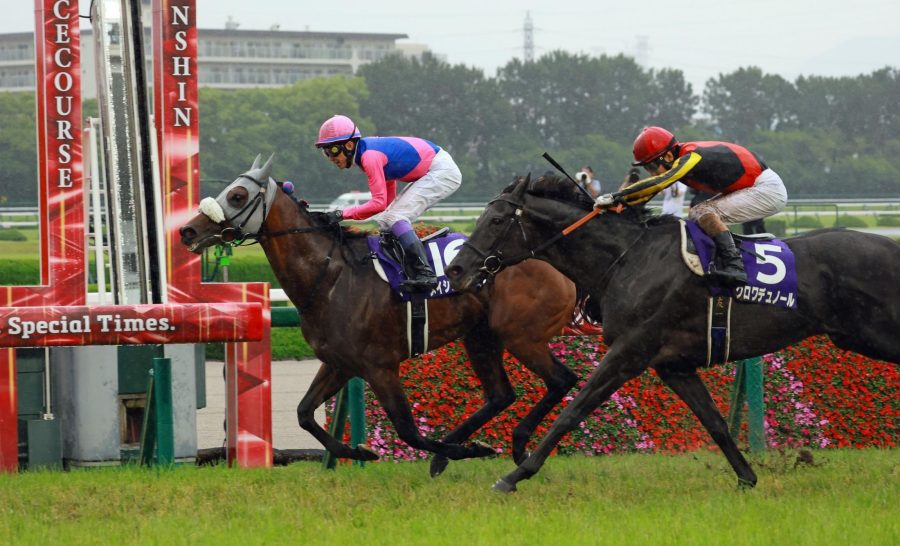
While the race has been shrouded with an understandable bit of discourse surrounding the ethics of horseracing with My Universe’s sad passing from heart failure, a nice bit of milestone has been achieved. Meisho Tabaru’s talent in running on softer turf combined with his affinity with Hanshin’s frontrunning preference and clear discipline saw him pull off a solid win to mark a father-son claim on 2 consecutive Takarazuka Kinens following Gold Ship. Croix du Nord’s Spring Triple Crown campaign is sadly vanquished, but his Arc expedition equips him with the experience to run well to 2nd place. Danon Decile lands 3rd as expected with a solid spurt that allows him to edge out Cosmo Kuranda’s runaway attempt. On the lightest note possible, I could’ve earned a good bit of money from betting given that the top 3 have made up my trifecta.
Positions at Bends

Sectional Time

Amateurish Analysis (Top 3)
Well, there has to be something about the best-performing racehorses in the race to warrant a deeper look into why they are able to excel as well as they did. In focusing on the top 3, we can look into both the moves made and the context surrounding their pedigree and their race records.
Meisho Tabaru
Like father, like son. Meisho Tabaru might only carry a third of his dad Gold Ship’s Group 1 races won (which is still a respectable 2 compared to 6 given the Japan Racing Association’s good bit of pickiness on G1s), but he’s able to accomplish what fans would see as a signature achievement of his in winning 2 consecutive Takarazuka Kinens. Tabaru’s clear experience of succeeding in Hanshin based on his race records combined with his demonstrable success with running on softer grounds with his breakout G3 Mainichi Hai win allows him to pull off the same feat.
What makes Meisho Tabaru’s win notable boils down to two key points. The first is that while his most convincing wins tend to boil down to runaway attempts as exemplified by his first Takarazuka Kinen win last year and his G1 Osaka Hai 2nd place this year, his performance here is more disciplined. Fans have worried previously that he might perform subpar to expectations should another frontrunner like Mystery Way aim to set the pace as well. This had happened last year in the Arima Kinen when the same problem played out in full that’s further amplified by the feinting by Cosmo Kuranda to look as though he’s going for the lead as well which in turn tired Tabaru out prematurely.
In this year’s Takarazuka Kinen however, Meisho Tabaru didn’t lose his cool when Cosmo Kuranda actually pulled a runaway bid nor did he exert himself hard to also do so as well. Rather, he runs more like a conventional pacesetter after the first corner once his main jockey Yutaka Take is able to wrestle a good bit of positioning from Sugar Kun. The top-right corner saw the downward slope, oftentimes an integral part in allowing those positioned from the front to succeed, be used to ready up Tabaru’s spurt in overtaking Cosmo Kuranda and push onward to win the race. Even with Croix du Nord on his tail, Tabaru’s able to hold on to his lead on the final straight to achieve his second G1.
The second key point is simple but is a big indication of the future plans later on this year. Tabaru’s clear talent in navigating around softer turfs are in full display with how he’s able to run the race despite the drizzling rain that’s happening until the end. The finishing time of 2:12.1 is a second slower than last year even with the runaway attempt. Yet, it’s worth keeping in mind that the JRA’s more meticulous management of the country’s turf means that the average finishing time tends to be faster than most other major countries/regions including Europe.
For a point of comparison, this year’s G3 Prix Hocquart, which is run at Longchamp in France under the same distance, clocks in at the finishing time of 2:15.5 (rounding up) mostly due to the softer turf. Last year’s G2 Prix du Conseil de Paris clocks in at 2:17.2 with a bit of rain beforehand. Tabaru’s victory in the Takarazuka Kinen points toward a possible entry into the prestigious G1 Prix de l’Arc de Triomphe as noted by some publications such as Idol Horse. Whether he’ll be able to launch that success into marking a dramatic milestone however is yet to be seen and while it’s worth tempering our expectations should he enter the race, his showing does hint towards a more competitive endeavour.
Croix du Nord
Over the course of this year, Croix du Nord looks set on being a national phenomenon with how he’s able to win the headlining G1s for medium-distance runners and stayers. He won the Osaka Hai in Hanshin where he’s able to edge out Meisho Tabaru after a preemptive spurt from the midfield to being close to the front by the final corner. He claimed the Spring Tenno Sho in his first ever attempt as a stayer by reaching the finishing line just before Wurttemburg’s dramatic surge. Given his experiences and his race records, all the signs would’ve pointed towards him being the first Spring Triple Crown champion.
Unfortunately, this race isn’t quite what he planned out. The rain that peppers Hanshin’s ground might not have nerfed Croix du Nord as much as most of the other entrants aside from Meisho Tabaru and Danon Decile, but it does leave his spurt a bit sluggish which makes the world of difference. Fans might blame the sighting of him being surrounded throughout the race which leaves no room for him to manoeuvre around until the final corner. And a few blame his main jockey Yuichi Kitamura for hugging the inner rail for what’s almost the entire race which leaves the run a bit unoptimised. Frankly speaking, I doubt that these decisions have lost the wunderkind the race. At least when it comes to the movements made.
Simply put, the simple fact that the rain softens the turf in Hanshin might have already doomed Croix du Nord’s Spring Triple Crown campaign. While he did do well in softer turfs given his win in the G3 Prix du Prince d’Orange last year in trying to run in l’Arc, it’s without a very close challenge as proved by his victory coming only by a short head further than later champion of the key French G1 Daryz. Kitamura could put him in the best possible position to correspond to the racetrack’s biases, but he’s simply not as well-prepared in running on softer grounds as Meisho Tabaru. All that being said, his 2nd place will leave him as the closest contender to achieve the Spring Triple Crown and it might inspire many to actually follow through with the rotations in the foreseeable future.
Danon Decile
The 2 G1-winning racehorse earns his fourth bronze in a G1 in yet another testament to his consistency as one of the top runners of his generation. In spite of the softer turf, being well close to the inner rail, and riskily placed towards the back until the downward slope, he’s still able to muster up the drive to clock in the fastest L3F time of 35 seconds on the final straight where he’s able to pull a wide swing to push through to overtake Cosmo Kuranda. He might not have collected as many top titles as fans would’ve wanted, but it’s admirable in and of itself to see how he’s always able to worm his way to a podium finish no matter what issues he might run into outside the worst case possible.


Another aspect that’s worth throwing in as a good bit of praise is Danon Decile’s main jockey Keita Tosaki. He might be the best-performing one in the race in terms of making the very best out of a bad situation. The aforementioned wide turn and the use of the inner rail to manage his stamina over the softer turf allows Decile himself to be able to carry on with his podium finishes especially with the spurt. It’s not hard to see why he’s a bit of a favourite all things considered. The duo are able to work together extremely well and are able to navigate around without overexerting too much in their runs.
The fun part now will be wondering where Danon Decile will head off to next. Given that he’s 5 years old with 2 G1s on top of several solid placements, chances are pretty high that he might retire this year to stand as a stud. His performance given the rain might point towards a possible short expedition in Europe including l’Arc although it might prove itself to be a stretch. Both Australia and the United States might also be a long shot as a next start given the proximity between the major races there and Japan’s autumn races like the Japan Cup and the Arima Kinen. It wouldn’t surprise me if the ultimate decision would be to cap his career off with a domestic run instead.
Amateurish Analysis (Other Competitors)
For the rest of the entrants, some have made moves that might have shaped the very way the race is run which makes for unexpected leanings that play to the advantage of others. This section is for those who either had done better than expected even if outside the top 3 or have shaped the race in a way that might have tilted the results in favour of others.
Cosmo Kuranda
The runaway of the race isn’t Mystery Way or Meisho Tabaru, but rather the runner-up of last year’s Arima Kinen whose form has always looked to be inconsistent. Cosmo Kuranda’s ceilings always tend to oscillate in the most unexpected time possible given that he regularly struggles to collect many graded titles. In the Takarazuka Kinen, he got off to a solid start before running in full force as if to mimic Silence Suzuka’s performance that saw him win the same race back in 1998. While he didn’t quite reach the finishing line and had slid down to 4th place, it’s a commendable effort which leads to the tempo being faster than expected. It would be fun to see how he’ll be adapted in Umamusume given his unexpected wacky hijinks in the top races of the country.
Tagano Dude
Tagano Dude has gone under the radar for a good while. However, his performance throughout the first half of this year demands a worthwhile honourable mention. He placed 4th in the Osaka Hai, 6th in the Spring Tenno Sho despite his experiences containing no stayer races, and now a top 5 in the Takarazuka Kinen. It’s clear that he didn’t like the softer turf at all given how far behind he is compared to the top 4, but his showing otherwise makes a good bit of hype around him in the future as a clear dark horse contender in an upcoming major race.
Regaleira and Museum Mile
Regaleira and Museum Mile share a lot of things in common. They’re regarded as midfield/end-closing runners who excel in Nakayama with 2 of their G1 wins being in the racecourse and whose jockeys are oftentimes born outside of Japan. They also share the unfortunate fact of placing outside the top 5 in the Takarazuka Kinen after a long layoff with Regaleira at 7th place and Museum Mile in 9th. Such a showing is going to be annoying for fans especially for Regaleira herself given that there’s a solid chance that she might retire at the end of this year to stand as a broodmare with the likely key goal being to at least be able to become one of a few female racehorses (probably the first even) to win the Arima Kinen twice.
As for Museum Mile himself? It must be stinging for him to have been burdened with nothing but bad luck this year. Compared to Regaleira whose longer spelling is said to be attributed to some minor health issues, Museum Mile isn’t supposed to be resting for 6 months straight given his prior plans of running in the Dubai Turf and Hong Kong’s Queen Elizabeth II Cup for his main G1 contentions. What’s especially painful is that he has a jockey cam video where the highlight comes more from Danon Decile’s strong showing with at least some thankful remarks on the safe finish.
My Universe
The biggest tragedy of the race is the passing of My Universe due to acute heart failure when he needed to be pulled out of the race before the final corner. It’s an unexpected event that appears to have little to no warning signs at all prior to the run and based on his training, fans would have thought of him as the likeliest candidate to pull off a major upset. Horseracing in general, even flat racing included which is seen as the safest in terms of statistics, can be very unforgiving in terms of equine health given the ethical concerns over breeding practices and major optimisation of peak physical performance over basic health checks.
I can’t blame some fans of Umamusume who get squeamish over horseracing even if it might come off as ironic or a major instance of cognitive dissonance on my part. I can’t also say as well that My Universe should’ve been pulled out of the race given that there appears to be virtually no signs of his health ailing even up to the start of the race. Those who are keenly supportive of massive animal rights or animal liberation will see this passing as a damning remark on the problems of horseracing and I can’t blame them at all for the reaction. Their heart is in the right place.
I do caution however that horses in general, not just Thoroughbreds like My Universe, aren’t exactly well-built as a species and that it’s a miracle at all that they’re able to exist as long as they did. There are 2 fantastic Tumblr posts as a start that I’ve originally discovered on the Umamusume subreddit which points out a simple nuance regarding the health of the horses by Dr Ferox. To put it simply, the concerns surrounding horses aren’t quite as simple as that of certain breeds being optimised to excel in athletic performances or to feed questionable human curiosity. Their biology quite simply makes them more fragile compared to a lot of other animals.
What I can say as a conclusion is that we have lost someone who is likely going to be a big what-if in Japan’s horseracing history. Whatever ups and downs he might endure would’ve been extinguished in his dramatic breakthrough in his G2 Nikkei Sho victory and given his form up until the Takarazuka Kinen, could’ve pulled off a big upset win. May he rest in peace and that in another life or universe, he’ll be able to reach up to his full potential as one of the most promising foals of his generation.
Leave a Reply